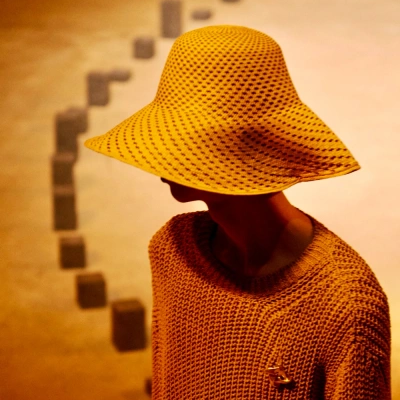


Balenciaga has announced the departure of creative director Pierpaolo Piccioli. The news came on Thursday 5 November, with the house saying a new creative direction would be named shortly. Piccioli leaves after only about 16 months in the role, one of the shortest tenures at a major Paris house in recent years.
Neither Balenciaga nor its owner, Kering, gave a reason. The statements were warm. Balenciaga president and CEO Gianfranco Gianangeli thanked Piccioli for his dedication and said he had reaffirmed the house’s couture origins through his approach to craftsmanship and construction.

Kering CEO Luca de Meo called him “an exceptional couturier and creative talent for whom we have the greatest respect.” De Meo added that the group’s ambition was to build on Balenciaga’s avant-garde spirit and make it a more powerful and relevant voice. On Instagram, Piccioli thanked his teams, writing that “each chapter exists to make way for the next.”
Piccioli’s Retrospective Take On Balenciaga
Piccioli’s arrival at Balenciaga was one of the headline moves of fashion’s 2025 creative reshuffle. Born in Nettuno, Italy, in 1967, he started his career at Fendi. He joined Valentino in 1999 as an accessories designer alongside Maria Grazia Chiuri. The pair became co-creative directors in 2008. When Chiuri left for Dior in July 2016, he became sole creative director. He left Valentino in March 2024 after 25 years at the house.
Kering announced in May 2025 that he would succeed Demna, who was moving to Gucci, and he started on 10 July that year. He took on womenswear, menswear, accessories and couture. Kering said at the time that it expected him to build on Demna’s ten-year success while staying close to the legacy of founder Cristóbal Balenciaga.
He turned to the house’s history. His first collection, shown in October 2025 for spring 2026, used colour blocking and big volumes that riffed on Balenciaga’s 1957 sack dress. For fall/winter 2026 he went darker, adding a collaboration with HBO’s Euphoria, and the collection got a lukewarm reception.

His most anticipated moment came on 8 July 2026, more than a year after he took over. He showed his first couture collection for the house, Balenciaga’s 55th, in the courtyard of the Cité Internationale Universitaire de Paris. In total he presented three ready-to-wear collections and one haute couture line. His position was always slightly exposed, because he had been hired before de Meo arrived and began a complete overhaul of the group.
A House in Need of a Reset
The commercial backdrop matters. Kering doesn’t report Balenciaga’s revenue on its own, but the trend in its group results is clear. In 2025, the Other Houses segment, which then included Balenciaga, swung to a €112 million recurring operating loss from a €9 million loss the year before. Kering blamed soft performance at Balenciaga and losses at Alexander McQueen. There was one bright spot, as Balenciaga’s retail performance turned positive over the year, driven by leather goods.
That split continued into 2026. In the third quarter, Balenciaga stayed resilient in leather goods, while ready-to-wear and shoes were still challenged. In the 22 October update, de Meo said Kering was “doubling down on the renewal of Balenciaga and Alexander McQueen.”

At its Capital Markets Day in Florence in April, Kering set out a demanding brief. The targets for Balenciaga were to double its leather goods, women’s ready-to-wear and US business. Women’s was to become the main engine of growth. De Meo said top clients already make up 25% of the business. He also wanted to push the brand’s cultural reach into areas including TV series, music, sports and gaming. Put simply, Kering wants Balenciaga to rely less on menswear and cultural momentum and more on women’s and leather goods.
Piccioli is the third high-profile designer to leave a Kering house in about a month. Anthony Vaccarello left Saint Laurent on 9 October, and Seán McGirr left Alexander McQueen in mid-October.